

Buying an enterprise SEO tools is one of the strangest purchases in marketing. You’re about to sign a contract worth somewhere between $15,000 and $400,000 a year, and almost none of the vendors will tell you the price until you’ve sat through two demos.
Most “best enterprise SEO tools” lists don’t help much either. Half of them are written by a vendor who ranks itself first. The other half list 22 tools with identical praise, so you finish reading and still don’t know what to buy.
This guide takes a different route. It compares the platforms large teams actually shortlist, shows real price ranges where they exist, and is honest about where each one falls short. More importantly, it gives you a way to decide, because the right answer depends far more on your problem than on anyone’s feature list.
The short answer enterprise SEO tools
If you just want the headline picks for 2026:
- Best overall platform for one source of truth: seoClarity
- Best for global content programs and AI search at scale: BrightEdge
- Best for content-led teams that need to prove revenue: Conductor
- Best for huge sites with crawl and indexation problems: Botify
- Best all-in-one for marketing teams that run SEO, paid and AI visibility together: Semrush Enterprise
- Best for backlink and keyword data: Ahrefs Enterprise
- Best for always-on technical monitoring: Lumar
No single tool wins every category. In practice, most enterprise teams end up with one core platform plus one or two specialists. The rest of this article explains how to pick that combination without overpaying.
What makes an SEO tool “enterprise” ?
An enterprise SEO tools is software built to manage search visibility across very large sites, many markets and many teams at once. The size of the site matters, but it isn’t the real dividing line. The real dividing line is coordination.
A small team can live happily with a rank tracker, a crawler and a spreadsheet. Once SEO touches developers, writers, product managers, regional teams and a CMO who wants a monthly number, that patchwork breaks. Three dashboards show three different traffic figures, and the weekly meeting turns into a debate about whose number is right.
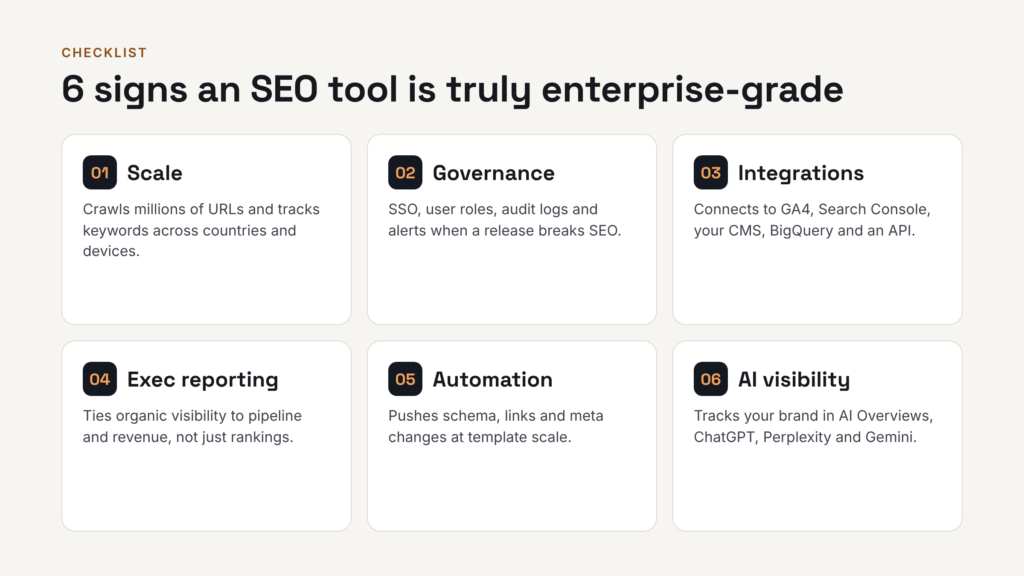
In practice, a tool earns the “enterprise” label when it handles most of these:
- Scale: crawling millions of URLs and tracking tens of thousands of keywords across countries, languages and devices.
- Governance: user roles, SSO, audit logs, and alerts when a release quietly breaks canonicals or noindexes a template.
- Integrations: GA4 or Adobe Analytics, Search Console, your CMS, a data warehouse like BigQuery, and an API.
- Reporting for people who don’t do SEO: dashboards that connect organic visibility to pipeline and revenue, not just positions.
- Workflow and automation: pushing schema, internal links or meta changes at template level without a dev ticket for every page.
- AI search visibility: tracking how your brand shows up in Google AI Overviews, ChatGPT, Perplexity and Gemini, which has moved from nice-to-have to standard in 2026.
Platforms vs point tools
This is the first real decision, and it’s worth making on purpose.
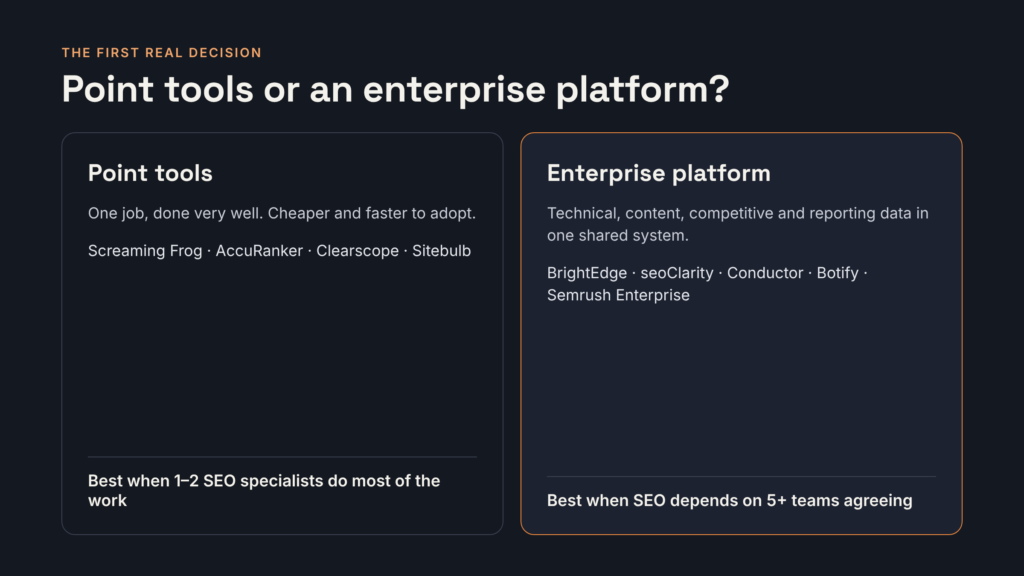
Point tools do one job very well. Screaming Frog crawls. AccuRanker tracks rankings. Clearscope grades content. They’re cheaper, faster to adopt, and specialists love them.
Enterprise platforms (BrightEdge, seoClarity, Conductor, Botify, Semrush Enterprise SEO tool) put technical, content, competitive and reporting data in one place. You pay for the integration and the shared source of truth, not only the features.
A simple rule: if one or two SEO specialists do most of the work, a smart stack of point tools usually beats a platform. If SEO depends on five or more teams agreeing on priorities, the coordination cost of separate tools starts to cost more than the platform license.
Enterprise SEO platforms compared at a glance
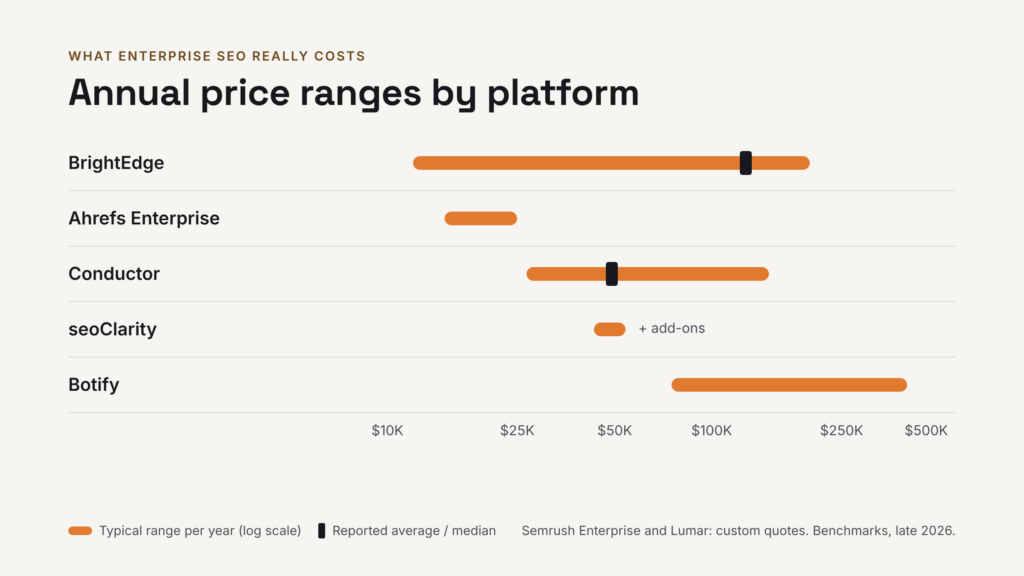
Here’s how the seven core platforms line up. Prices are starting points or published third-party benchmarks as of late 2026. Your real quote will depend on domains, keyword volume, seats and modules.
| Platform | Best for | Typical price | Biggest strength | Main watch-out |
|---|---|---|---|---|
| seoClarity | One source of truth for rankings, content, technical and analytics | From $3,600/month (1 domain) | ClarityAutomate pushes schema and links at template scale | Steep learning curve |
| BrightEdge | Global brands with many markets and big content teams | ~$12K/year entry; enterprise deals often six figures | Data Cube demand data plus AI Catalyst for AI search | Custom pricing, 2–3 month onboarding |
| Conductor | Content-led teams tying SEO to revenue | ~$27K/year floor; median near $49K | Intent research turned into writer-ready briefs | Lighter on deep crawl and log analysis |
| Botify | Sites with 500K+ URLs and indexation pain | ~$75K–$150K/year mid-size; $400K+ at the top | Log file analysis and crawl budget insight | Overkill for smaller sites |
| Semrush Enterprise SEO Tool | Teams running SEO, AI visibility and competitive research together | Custom (self-serve Business tier is $499.95/month) | Huge keyword and backlink data plus AI Optimization | Breadth turns into sprawl without owners |
| Ahrefs Enterprise SEO Tool | Link intelligence and keyword research | From about $14,990/year | One of the biggest backlink indexes | Light on workflow and governance |
| Lumar | Always-on technical monitoring | Custom | Real-time alerts when releases break SEO | Technical only, no content or keyword research |
The 7 best enterprise SEO platforms, reviewed
1. seoClarity: best for one SEO source of truth
seoClarity is the platform for teams whose biggest problem is fragmentation. It pulls rankings, site audits, content data and analytics into one workspace, so everyone argues about strategy instead of about which number is correct.
The standout is ClarityAutomate. It lets you roll out schema, internal links and on-page changes across thousands of templated pages without waiting on engineering. If your SEO roadmap is stuck in a dev backlog, that feature alone can justify the license. Its AI assistant, Sia, also turns SERP research into briefs and outlines.
Where it falls short: the depth is the downside. New users hit a wall in the first weeks, and teams without a dedicated SEO owner tend to use a small slice of it. It’s pure SEO, so paid and social still live elsewhere.
Pricing: one of the few that publishes a floor, from $3,600/month for a single domain and $4,500/month for multiple domains.
2. BrightEdge: best for global brands and AI search at scale
BrightEdge has been the default “big brand” platform for years, and it’s still built around that buyer. Data Cube reads search demand across many markets at once, ContentIQ audits millions of pages, and Share of Voice shows who you actually compete with by category, product line or region.
In 2026 its AI search tooling is the main story. AI Catalyst tracks visibility inside Google AI Overviews and answer engines, and newer modules cover AI agent activity. Copilot and Autopilot handle AI-assisted recommendations and roll fixes out across large page sets.
Where it falls short: BrightEdge rewards structure. Without clear owners for research, audits, content and reporting, expensive modules sit unused. Onboarding typically runs two to three months, and pricing is custom only.
Pricing: independent benchmarks put entry contracts near $12,000/year, with full enterprise deployments commonly well into six figures.
3. Conductor: best for content-led teams that answer to the CFO
Conductor is the right call when content drives your SEO program and leadership wants to see revenue, not rankings. It’s strong on search intent and audience research, and its Content Guidance compares your pages with top competitors and flags gaps in structure and coverage.
It absorbed ContentKing years ago, so you also get real-time monitoring that alerts you when an indexing problem or traffic drop appears. AI visibility tracking is tied to GA4 conversions, which makes the reporting land well with executives.
Where it falls short: it’s lighter on deep crawl and log file analysis than Botify or Lumar. Very large catalogs usually pair it with one of those. The ROI features also assume your GA4 setup is clean, and many aren’t.
Pricing: custom. Purchase data reported by Vendr shows a floor around $26,800/year and a mid-market median near $48,950. Budget extra for implementation in year one.
4. Botify: best for huge sites with crawl and indexation problems
If your site has hundreds of thousands or millions of URLs and traffic is sliding without an obvious cause, Botify is usually the tool that finds out why. Its crawler handles millions of URLs, and its log file analysis shows exactly how Googlebot spends its crawl budget: wasted on faceted URLs, missing your money pages, or stuck on rendering.
Botify is organized as Analytics, Intelligence and Activation. Activation can push pages toward indexation through CDN-level integrations, which is a real edge for e-commerce and marketplaces.
Where it falls short: it’s a technical platform, so content teams get little from it. Below roughly 500,000 URLs, a desktop crawler plus a keyword tool covers most of what you need for a fraction of the price. You also need a technical SEO owner who can act on dense data. One practical snag: many enterprises struggle to get IT to hand over server logs, so confirm log access before you sign.
Pricing: custom, no free trial. Benchmarks put mid-size deployments around $75,000–$150,000/year, with the largest contracts above $400,000.
5. Semrush Enterprise SEO Tool: best all-in-one for modern marketing teams
The biggest change on this list in 2026 is ownership. Adobe completed its acquisition of Semrush in late April 2026, and the enterprise product now sits inside Adobe’s customer experience stack. A joint “Adobe Brand Visibility” offering already links Semrush’s search data with Adobe’s optimization tools. If your company runs on Adobe Experience Cloud, that’s worth a serious look.
On its own merits, Semrush Enterprise tool SEO combines SEO, AI Optimization (brand visibility tracking across AI models), Site Intelligence for crawling millions of pages, and a very large data layer. Semrush says that layer covers about 28.7 billion keywords and 43 trillion backlinks. Automated internal linking is a practical highlight for big multilingual sites.
Where it falls short: breadth becomes sprawl. Without owners for each module, teams use a fraction of it. Very large sites may still want a dedicated crawler.
Pricing: Enterprise is custom. The self-serve Business plan runs $499.95/month, which some mid-size teams find is enough.
6. Ahrefs Enterprise tool: best for link intelligence and keyword depth
Ahrefs is the best pure-data tool here. It has one of the largest backlink indexes in the industry, and Site Explorer, Keywords Explorer, Rank Tracker and Site Audit cover most daily research. The Enterprise tier adds API access, SSO, audit logs, unlimited history and higher limits. Brand Radar adds AI visibility tracking.
SEOs rate its API highly for research at scale, such as checking link profiles for top pages across thousands of keywords in a new market.
Where it falls short: it’s data-first, not workflow-first. There’s no real governance layer or shared content workflow, so content-heavy programs pair it with something else. Extra seats and crawl needs raise the cost quickly.
Pricing: Enterprise is listed at $1,499/month with an annual commitment, roughly $15,000/year after the annual discount.
7. Lumar: best for always-on technical monitoring
Lumar (formerly Deepcrawl) works less like an audit tool and more like a smoke alarm. It crawls continuously and alerts you when a release adds noindex tags, breaks internal links or changes canonicals, often before traffic drops.
That makes it ideal for fast-moving sites with several dev teams shipping changes. Governance features let you enforce technical standards across regions, and segmentation by template or folder helps you fix what matters most first.
Where it falls short: it does technical SEO only. You’ll need separate tools for keywords, content and links.
Pricing: custom, based mainly on crawl volume and domains.
Specialist tools worth adding to your stack
Even the biggest platforms have gaps. These specialists fill them, often for a small fraction of the cost.
Technical SEO and crawling
- Screaming Frog SEO Spider ($279/year per license): the crawler almost every enterprise SEO still keeps open. Run it on a cloud server and it handles very large sites, with JavaScript rendering, custom extraction and crawl comparison.
- Sitebulb Cloud ($125–$495/month, enterprise custom): cloud crawling plus clear, prioritized “Hints” that make findings easy to hand to developers.
- Lumar and Botify: covered above, for continuous monitoring and log-based crawl intelligence.
Rank tracking and share of voice
- STAT Search Analytics (custom): built for tracking tens or hundreds of thousands of keywords daily across markets, with deep SERP feature data.
- AccuRanker (from $249/month for 2,000 keywords): fast, accurate, on-demand rank updates and a good API.
- Advanced Web Ranking ($139–$980+/month): flexible segmentation and reporting, a favorite of agencies managing many clients.
Content optimization
- Surfer (enterprise from $999/month): SERP-based briefs and content scoring that keep large writing teams consistent.
- Clearscope ($129–$399/month, enterprise custom): a cleaner, writer-friendly grader for teams that care about editorial quality.
- MarketMuse (custom): topic modeling for building authority across whole content libraries.
- AirOps (custom at enterprise level): AI content workflows with human approval steps, useful for refreshing content at scale.
AI search visibility
This category barely existed two years ago. Now it’s on every RFP. BrightEdge, Semrush, Conductor and Ahrefs all include some form of AI visibility tracking. Specialist tools such as Analyze AI focus entirely on prompt-level tracking across ChatGPT, Perplexity, Gemini and others, and on tying those mentions to GA4 traffic.
One caution: AI visibility data is still young. Prompt sets differ between vendors, and results vary by run. Use it to spot trends and gaps, not as a precise number to report to the board.
The free layer you still need
Google Search Console, GA4 and Bing Webmaster Tools remain the only first-party data you’ll get. Every platform above builds on them. Search Console caps exports at 1,000 rows in the interface, which is why tools like SEOTesting exist to pull and test that data properly.
How to choose the right enterprise SEO tools
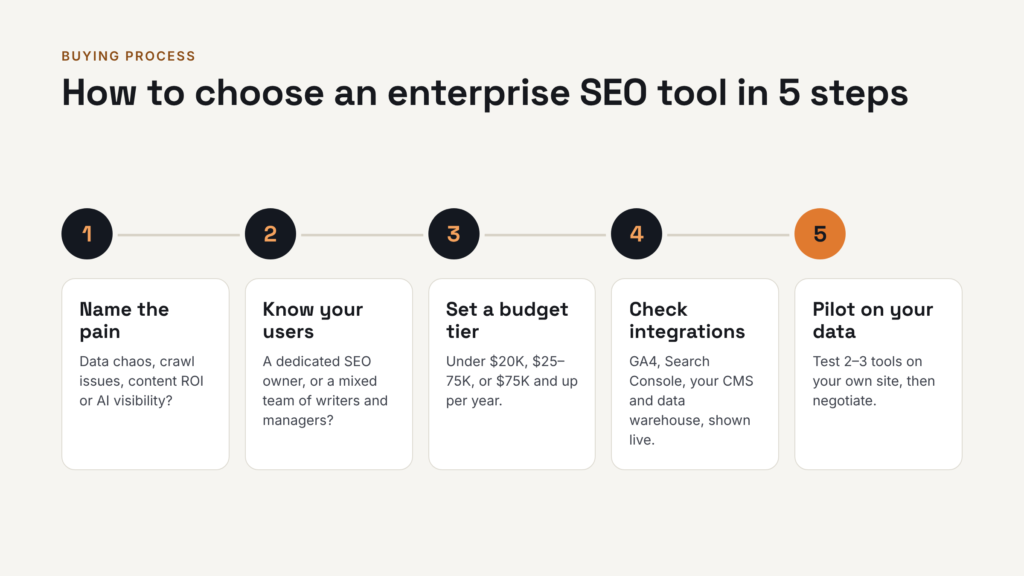
Start with your most painful problem, not with a feature checklist. Feature lists look nearly identical across vendors by now. The problems they’re truly best at solving don’t.
Step 1: Name the pain
| If your biggest problem is… | Start your shortlist with |
|---|---|
| “Nobody agrees on the numbers” | seoClarity, Conductor |
| “Google isn’t crawling or indexing our important pages” | Botify, Lumar |
| “Releases keep breaking SEO and we find out weeks later” | Lumar, Conductor (real-time monitoring) |
| “Content isn’t moving revenue” | Conductor, BrightEdge |
| “We run 30+ country sites” | BrightEdge, seoClarity, Semrush Enterprise |
| “We’re invisible in ChatGPT and AI Overviews” | Semrush Enterprise SEO tool, BrightEdge, Conductor, a dedicated AI visibility tool |
| “We need deep link and competitor data” | Ahrefs Enterprise tool, Semrush Enterprise |
Step 2: Be honest about who will use it
Botify, BrightEdge and seoClarity reward a dedicated owner. Without one, you’ll pay for a Ferrari and drive it to the shops. Conductor, Semrush and Ahrefs are friendlier for mixed teams where writers, product marketers and managers log in too.
Step 3: Match the budget to a realistic tier
- Under $20K/year: Ahrefs Enterprise or Semrush Business, plus Screaming Frog and a content grader.
- $25K–$75K/year: Conductor or an entry BrightEdge contract, plus a crawler.
- $75K and up: BrightEdge, seoClarity or Botify as the core, with specialists around it.
Step 4: Check integrations before features
Ask each vendor to show, live, how their tool connects to your actual stack: GA4 or Adobe Analytics, Search Console, your CMS, and your data warehouse. A platform that can’t feed your BI dashboards will end up as one more silo.
Step 5: Run a real pilot
Don’t judge on a polished demo account. Ask for a trial or proof of concept on your own site, with your own messy data. Pick two or three questions you need answered and see which tool answers them fastest.
Three example stacks
- Large e-commerce site (1M+ URLs): Botify for crawl and logs, Semrush Enterprise or Ahrefs for research, AccuRanker or STAT for rankings.
- Global B2B brand with a big content team: Conductor or BrightEdge as the core, Clearscope for writers, Screaming Frog for spot checks.
- Lean in-house team at a fast-growing company: Semrush Business or Ahrefs Enterprise, Sitebulb Cloud, Surfer, plus Search Console data through a testing tool.
What enterprise SEO tools really cost
The license is only part of the bill. For a realistic first-year budget, add:
- Implementation and services: for platforms like Conductor, these can add 50–100% to year-one cost.
- Extra seats and modules: AI visibility, content and local SEO are often sold as add-ons.
- Training time: two to three months of onboarding is normal for the heavier platforms.
- Renewal increases: one spend-tracking firm reported BrightEdge enterprise pricing rising about 14.5% year over year. Ask for a renewal cap up front.
Negotiation tips that actually work
- Get at least two competing quotes. Enterprise SEO pricing is a negotiation, not a price tag.
- Buy at the end of the vendor’s quarter. Sales teams have more room to discount when they’re chasing a number.
- Negotiate a multi-year deal only with a price lock. Otherwise you carry the risk and they keep the upside.
- Trade length for flexibility. If you sign for longer, ask for the right to swap modules or reduce seats.
- Pay for what you’ll use in year one. Add modules later, when there’s an owner ready to use them.
Common mistakes to avoid
- Buying the platform before hiring the person. A six-figure tool with no owner becomes an expensive login page.
- Choosing on the demo. Demo accounts are clean. Your data isn’t.
- Ignoring the exit. Check how you can export your historical ranking and crawl data if you leave.
- Treating AI search as a separate project. It’s the same content and technical foundations, measured on new surfaces. Pick tools that show both side by side.
Frequently asked questions
What are the best enterprise SEO tools in 2026 ?
The platforms most large teams shortlist are seoClarity, BrightEdge, Conductor, Botify, Semrush Enterprise, Ahrefs Enterprise and Lumar. The best one depends on your main problem: data fragmentation, global content, technical scale, or competitive research.
What’s the difference between an enterprise SEO platform and an SEO tool ?
An SEO tool solves one task, such as crawling or rank tracking. An enterprise SEO platform combines technical, content, competitive and reporting data so many teams work from the same numbers. Platforms cost more because you’re paying for that shared system.
How much do enterprise SEO platforms cost ?
Roughly $15,000 to $50,000 a year at the entry level, and $100,000 to $400,000+ for global deployments. Ahrefs and seoClarity publish starting prices. Most others quote custom.
Do I need an enterprise SEO platform or enterprise SEO services ?
They solve different problems. A platform gives your team data and automation. Enterprise SEO services, meaning an agency or consultancy, give you people and strategy. Many companies need both: if you lack in-house SEO staff, hire expertise first, because the best tool in the world doesn’t fix anything on its own.
Do enterprise SEO tools track AI search visibility ?
Most now do. BrightEdge, Semrush Enterprise, Conductor and Ahrefs all track brand mentions or citations in AI Overviews and chatbots like ChatGPT and Perplexity. Treat the data as directional, since methods still vary between vendors.
Can smaller companies use enterprise SEO tools ?
Yes, but they usually shouldn’t pay for a full platform. A mid-tier Semrush or Ahrefs plan, a crawler and a content grader cover most needs until SEO involves many teams or very large sites.
Final thoughts (enterprise SEO tools)
The best enterprise SEO tool is the one your team will actually use to fix the problem that costs you the most traffic. For a fragmented team, that’s a single source of truth. For a giant catalog, it’s crawl intelligence. For a content engine, it’s revenue reporting.
So start with the pain, shortlist two or three platforms, test them on your own data, and negotiate hard. Get those four steps right and the tool becomes an advantage instead of another expensive login.

